Showing posts with label War Film. Show all posts

Jakob The Liar

File:Jakob the liar poster.jpgJokob The Liar, a 1999 American tragicomedy film directed by Peter Kassovitz is a remake film of 1975 East German-Czechoslovakian Holocaust film Jacob the Liar directed by Frank Beyer and based on the eponymous novel by Jurek Becker published in 1969.

The name "Jacob" is related to Jewish history and culture. In the biblical story of Jacob, from the Book of Genesis, Jacob tells a lie to his father Isaac in order to steal the first-born birth-right from his older brother Esau. According to classic Jewish texts, Jacob lived a life that paralleled the descent of his offspring, the Jewish people, into the darkness of exile.

During World War II in Nazi occupied Poland of early 1944, a Polish-Jewish shop keeper named Jakob Heym (Robin Williams) is summoned to Ghetto headquarters on a charge he broke the curfew. While waiting for the German Kommondant, Jakob overhears a German radio broadcast about Russian troop movements and the defeats of the German Army. Returned to the Ghetto, Jakob shares his information with a friend Mischa (Liev Schreiber) who wants to risk his life by escaping. Mischa eventually spreads the lie out that Jakob possesses a radio since no one will believe he went to the Ghetto office and came back alive.

Jakob is now forced to become creative to tell favorable tales of information from "his secret radio". He has to provide new items of fictional news each day in order to help maintain the peace and hope and prevent despair from returning to the Ghetto. However, the Gestapo get wing of the stories, they become convinced that someone has communications equipment stashed away somewhere and they demand the person with the radio to give himself up or risk hostages being killed. Jakob surrenders himself to the Germans and tells them that he had only listened to the radio inside German Kommondant's office. He is ordered to announce publicly that this was all a lie but Jakob refuses to tell the truth when presented to the public and he is shot before he can make his own speech.

This is an old firm but still worth watching it again. Many Jewish prisoners died in the concentration camp through deliberate maltreatment, disease, starvation and overwork or were executed as unfit for labor. Jakob the Liar shows another tragic aspect of the Holocaust and in the film, many have attempts to hang themselves or risk their life escaping to end the situation cause they do not see a future but Jakob with his own individual's unique attempt brings hope and faith alive in the desperate situation.

Movie Trailer:


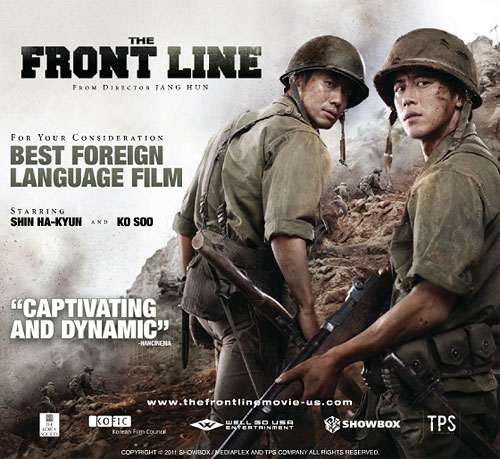
The Front Line (고지전)

The final battle of Korea war that determined the border between North and South - The Front Line (고지전). A 2011 South Korean war film directed by Jang Hun set during the 1953 ceasefire of Korea war.


Despite the ceasefire negotiations which began on July 10, 1951 at Kaesongon, the fighting continues around the Aerok Hills on the eastern front to determine the future dividing line between the North and the South. The hills continue to change hands so frequently that the generals at the negotiation table can't even keep track of it.

First Lieuenant Kang Eun-pyo (Shin Ha-kyun) of the Defense Security Command is sent to the front to investigate the murder of a South Korean officer commanding Alligator Company who is found dead by a Southern bullet and also to discover if there is a mole in the unit when mail from a North Korean soldier to his family in the South is found.

Upon arrival, Kang is immediately shocked at the state of the soldiers, the conditions on the front and the presence of a former friend, Kim Soo-Hyeok (Go Soo) who he believed to be dead early in the Korea war. A disarray unit led by Kim because of the high kill rate in the dangerous region. With a truce promised for years but no end in sight, one man struggles to make sense of a crime in the face of countless lives sacrificed for war.

Though the characters in the film are fictional and the symbolic hill called Aerok in the film is form by the word "Korea" in backwards but the war between the North and South Korea is real and it shows the seriousness as it comes to the consequences of the war for a small, strategic hill on the front. Like what Kim in the film said, "Our enemy wasn't commies, but the war itself."

The film ends with Kang walking down the hill among the corpses of all the fallen soldiers, leaving the fate of Aerok Hill unknown.

Full Movie (With English Subtitles):


J.S.A.: Joint Security Area

Joint Security Area (공동경비구역 JSA) is a 2000 South Korean film directed by Park Chan-wook and is based on the novel DMZ by Park Sang-yeon. The film, which was shot on location in South Korea, concerns an investigation into the circumstances surrounding a fatal shooting incident within the DMZ, the heavily fortified border that separates North and South Korea.

The film opens with a shooting along the heavy militarized border between North and South Korea, which leaves a North Korean soldier Pvt. Chǒng U-jin (Shin Ha- Kyun) dead and a South Korean soldier Sgt. Lee Soo-hyeok (Lee Byung-hun) on border duties, attempts to flee back to the South Korean side.

Hoping to reduce the potentially explosive political fallout by solving the crime quickly, both countries agree on a special investigation conducted by Major Sophie E Jang (Lee Yeong-Ae) on behalf of the Neutral Nations Supervisory Commission.

In a politically-sensitive place where safety is ensured by covering-up the truth, the young lady investigator learns that things are often not what they seem. As she methodically sifts through the evidence, Sophie learns that the testimony of two other soldiers, North Korean Sgt. Oh Kyeong Pil (Song Kang-Ho) and South Korean Sgt. Lee Soo Hyeok (Lee Byung-Hun) are completely contradictory. Another witness Pvt. Nam Sung-shik (Kim Tae-Woo) tries to commit suicide rather than divulge information.

In her ardent desire to uncover the details of the bizaare incident, she risked the eruption of a serious conflict and discovers a tragic story of friendship.


Movie Trailer (With English Subtitles):


Charlie Wilson's War

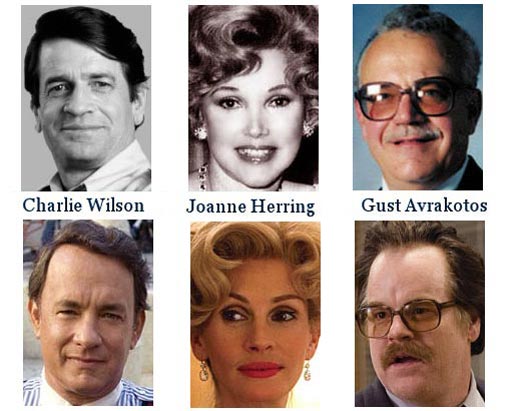
Charlie Wilson's War posterCharlie Wilson's War directed by Mike Nichols, is a 2007 American biographical drama film, recounts the true story of U.S. Congressman "Good Time Charlie" Wilson (TX) who partnered with CIA operative Gust Avrakotos and wealthy Texas supporter Joanne Herring to launch Operation Cyclone, a program to organize and support the Afghan mujahideen during the Soviet war in Afghanistan, 1979 to 1989.

In the early 1980s, Congressman Charlie Wilson (Tom Hanks) represents the second congressional district in Texas who is also an illicit drug user and womanizer. He lives a wild, party life, highlighted by parties in Las Vegas hotels with strippers and hot tubs and staffs his office with attractive young women. Charlie is able to get away with all this behavior since little scrutiny is placed on him because no one pays any attention to him. Charlie Wilson's War (2007) starring Tom Hanks, Julia Roberts, Philip Seymour Hoffman, based on George Crile's book Charlie Wilson's War

One day, he sees a network news reports on TV and speaking to one of his women friends, the wealthy Joanne Herring (Julia Roberts), a right wing, fundamentalist Christian zealot and begins an interest in the Soviet occupation of Afghanistan. Joanne encourages Charlie to do more to help the Afghan people and persuades him to visit the Pakistani leadership. In visiting to Pakistan, the Pakistanis complain about the inadequate support of the U.S. to oppose the Soviet Union and they insist that Charlie visit a major Pakistan-based Afghan refugee camp. Charlie is deeply moved by their misery and determination to fight but is frustrated by the regional CIA personnel's insistence on a low key approach against the Soviet occupation of Afghanistan. Charlie returns home to lead an effort to substantially increase funding to the mujahideen.

With the help of rogue CIA agent, Gust Avrakotos (Philip Seymour Hoffman), the two men supplied money, training and a team of military experts that turned the ill-equipped Afghan freedom-fighters into a force that brought the Red Army to a stalemate and set the stage for conflicts in the Middle East that still rage to this day.

Charlie learns that his personal life may come back to haunt him and that winning the war may come with unexpected consequences since his tasks are not easy as he has to bring together not only disparate but often hostile opposing political and religious forces to achieve his goal.

The film ends with Charlie being the first civilian receiving the Honored Colleague Award by the CIA.

These things happened.
They were glorious and they changed the world ... ...
A change is brought about because ordinary people do extraordinary things.

Movie Trailer:


The Pianist

File:The Pianist movie.jpgThe Pianist is a 2002 biographical war drama film directed by Roman Polanski who as a boy growing up in Poland watched while the Nazis devastated his country during World War II. The film is based on the true story of a Polish-Jewish musician Wladyslaw Szpilman (5 December 1911 – 6 July 2000) who spent five years struggling against the Nazi occupation of Warsaw.

In the 1930s, Wladyslaw Szpilman (Adrien Brody) who born to a wealthy Jewish family was known as the most accomplished piano player in Poland. The Szpilmans have a large and comfortable flat in Warsaw which Wladyslaw shares with his family. While Wladyslaw and his family are aware of the looming presence of German forces and Hitler's designs on Poland, they are convinced that the Nazis are a menace which will pass and that England and France will step forward to aid Poland in the event of a real crisis.

In September 1939, a German bomb rips through a radio station while Wladyslaw plays live on the air and shattered his naivete. As the German grip tightens upon Poland, Wladyslaw and his family are selected for deportation to a Nazi concentration camp. Refusing to face a certain death, Wladyslaw at last deciding to escape and goes into hiding in a comfortable apartment provided by a friend. However, when his benefactor goes missing, Wladyslaw is left to fend for himself and he spends the next several years dashing from one abandoned home to another, desperate to avoid capture by German occupation troops.

WLADYSLAW SZPILMAN
In August 1944, Polish resistance mounts the Warsaw Uprising, attacking a German building across the street from Wladyslaw's hideout. A tank shells his apartment and he is forced to flee and hide elsewhere as fighting rages around. Over the course of the next months the city is destroyed and emptied of the population and Wladyslaw, entirely alone, searches desperately for shelter and supplies among the ruins. Until one night, he is discovered by the Nazi officer, Captain Wilm Hosenfeld (Thomas Kretschmann), who learns that Wladyslaw is a pianist and asks him to play on the grand piano nearby. The decrepit Wladyslaw plays "Ballade in G Minor", which moves Hosenfeld, who then helps him survive, allowing him to hide in the attic of an empty house and regularly brings him food.

WILM HOSENFELD
When Russian army draws closer to Warsaw in January 1945, Hosenfeld gives Wladyslaw a final parcel of food and his overcoat to survive for a few more days when the Russian army will liberate him soon. He asks Wladyslaw of his surname, which sounds exactly like "spielmann", the German word for pianist and Hosenfeld promises to listen for him on the radio. Shortly afterward, Wladyslaw sees Polish partisans and overcome with joy, goes outside to meet his countrymen. Seeing his coat given to him by Hosenfeld, they think he is a German and try to kill him, before he can convince them he is Polish.

Newly freed Poles walk past an improvised Russian prisoner of war camp and Hosenfeld is among the prisoners. The Poles hurl insults at the Germans through the fence but when Hosenfeld hears that one of the Poles is a musician, he goes to the fence and tells him that he has helped Wladyslaw and asks him to ask Wladyslaw to return the favor, before a Russian soldier throws him back down on the ground. The Polish musician visits Wladyslaw and takes him to the site but they have vanished. Wladyslaw is unable to help Hosenfeld, but he returns to play piano for the radio station.

At the ending of the film, it tells Hosenfeld died in a Soviet Prisoner-of-War Camp in 1952 and Wladyslaw lived to be an old man, dying in Warsaw at the age of eighty-eight.

Movie Trailer:


Chopin Ballade No. 1 in G minor, Op 23

Life Is Beautiful

"Life Is Beautiful" is an Italian language film which tells the story of a Jewish Italian, Guido Orefice (played by Roberto Benigni, who also directed and co-wrote the film), who must employ his fertile imagination to help his son survive their internment in a Nazi concentration camp (a camp which maintained by Nazi Germany, under Adolf Hitler throughout the territories it controlled). This film was released in October 1998 and is an unforgettable fable that proves love, family and imagination conquer all.

The film starts in the 1930s, Guido, an Italian Jew, falls in love with a school teacher, Dora, who isn't Jewish. He woos her and steals at her engagement from her rude and loud fiance, a Fascist official. They get married and several years later, their son Giosue grows up among growing anti-Semitism. During WWII, Guido and Giosue are arrested and taken to a concentration camp. Dora goes too, determined not to separate the family. In the midst of the horrors of the camp where the old and the children are killed because they are not strong enough to work, Guido protects his son by pretending that survival in the concentration camp is an elaborate game with which Giosue must play along or be sent home. Various levels of creativity are used by Guido to protect his son in the camp.

This is a great film of love, optimism, courage and inner strength and I was being moved by the love of a father; a sacrificing of a father made for the son which he created lights for him to move forward in continuing while facing with obstacles. Even right until the end of his life, he still not forgeting to make his son laugh one last time by imitating the Nazi guard as if the two of them are marching around the camp together. The son, Giosue manages to survive, and thinks he has won the game when an American tank arrives to liberate the camp and not knowing that his father has died. A truly sad tragedy and encouraging film.

"The happiest of people don't necessarily have the best of everything; they just make the most of everything that comes along their way."


LIFE IS BEAUTIFUL - Noa

Smile, without a reason why
Love, as if you were a child
Smile, no matter what they tell you
Don't listen to a word they say
Cause life is beautiful that way

Tears, a tidal wave of tears
Light, that slowly disappears
Wait, before you close the curtain
There is still another game to play
And life is beautiful that way

Here with his eyes forevermore
I will always be as close as you
Remember from before
Now that you're out there on your own
Remember what is real and
What we dream is love alone

Keep the laughter in your eyes
Soon your long awaited prize
We'll forget about our sorrows
And think about a brighter day
Cause life is beautiful that way

We'll forget about our sorrows
And think about a brighter day
Cause life is beautiful that way
There's still another game to play
And life is beautiful that way

Here's the links:
Movie Trailer

The Game Rule

Beautiful That Way - Noa